A few years ago, booking an interpreter meant finding someone who could physically be in the room. Today a clinic in a small town, a legal aid office or a field team in another country can reach a trained linguist in under a minute. Video remote interpreting has quietly become one of the most useful tools in language access, yet many organisations still treat it as a fallback rather than a planned service. This guide explains how video remote interpreting works, where it shines, where it struggles, and how to set it up so that the people who depend on it are actually understood.
What video remote interpreting actually is
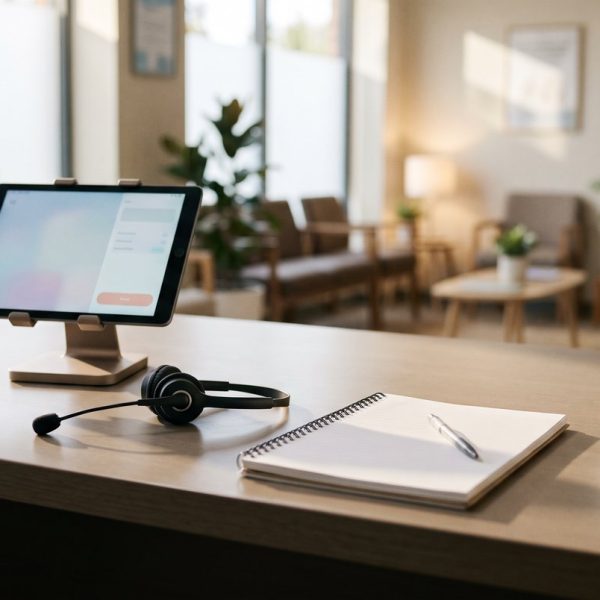
Video remote interpreting, often shortened to VRI, connects a speaker and an interpreter through a live video link. The interpreter can see facial expressions, gestures and the setting, which matters more than people expect. Unlike a phone call, the interpreter picks up on a hesitant look, a gesture toward a body part or a document being passed across a desk. VRI is usually delivered through a tablet, laptop or a dedicated cart, and it can be scheduled in advance or requested on demand within seconds.
It is worth separating VRI from on-site interpreting, which places the linguist in the room, and from audio-only services. Each has a place, and the best programmes use more than one. The question is never which format is best in general but which suits a particular conversation, at a particular moment, with a particular person.
Where video remote interpreting works best
The strongest use cases are short to medium conversations that cannot wait for a booking: a hospital intake, a pharmacy consultation, a police desk enquiry, a housing appointment or a customer service escalation. It also solves the problem of rare languages. A rural service may never find a local Pashto or Tigrinya interpreter, but a remote one can join in seconds. For organisations with staff across several sites, a single pool of interpreters is far easier to manage than a patchwork of local contracts.
Because the interpreter can see the room, VRI also suits sign-language work and situations in which visual context carries meaning, such as explaining how to use a medical device or filling in a form together. For international teams and NGOs, it makes briefings with partners in other time zones practical without the cost of travel.
Where it struggles
VRI depends on a stable connection, decent audio and a screen that everyone can see. In a noisy emergency room or an area with weak mobile coverage, quality drops quickly and the interpreter has to ask for repetitions that interrupt the flow. Very long sessions, emotionally charged hearings and multi-party meetings with many speakers are usually better served by an on-site interpreter, who can manage turn-taking and read the room more naturally.
There is also the human side. Some patients and clients find a screen impersonal, particularly when the topic is sensitive. A short introduction from the staff member, explaining who the interpreter is and that everything is confidential, goes a long way. Staff should speak directly to the client rather than to the screen, in short sentences, pausing so the interpreter can render each part accurately.
Phone interpreter services as a companion, not a rival
For quick, audio-only needs, phone interpreter services remain valuable. They work on any device, need almost no setup and cope well when bandwidth is poor. Many organisations keep both options available and let staff choose according to the situation. A recent look at phone interpreter services explains when a simple call is enough and when adding video is worth the effort.
Video remote interpreting solves most of what the article describes, and it has made specialist language pairs available in places that could never have sourced them locally. It still struggles when several people talk at once or when documents are passed across a table. Teams closing a transaction usually arrange on site interpretation for the signing itself, where exactly those conditions apply and a dropped connection is unacceptable.
If you want a broader practical overview of how these services are delivered, PoliLingua has a useful explanation of how telephone interpreting is arranged from the buyer's side, including questions to ask before signing a contract.
How to set up video remote interpreting properly
Start with the basics: a reliable network, a camera and microphone that work, and a private space where confidential conversations cannot be overheard. Test the equipment before the first real session, not during it. Decide in advance who can request an interpreter and how, and put a one-page quick guide next to the device so that staff do not have to remember the steps under pressure.
Next, choose the provider with care. Ask about interpreter qualifications and any specialist training, such as medical or legal terminology. Find out how long it takes to connect for the languages you need most, what happens if the connection fails, and how data is handled. Confidentiality is not a detail: interpreters hear health, legal and financial information, and the service should be covered by clear privacy terms.
Measuring whether it is working
Track a few simple measures: how often an interpreter was requested, how long it took to connect, which languages were needed and what staff and clients thought of the experience. Patterns will show where to add coverage or adjust the format. If one language is always in demand, a scheduled booking may be more efficient than on-demand calls. If a particular site struggles with connection quality, a different device or a phone fallback may be the answer.
For readers who want background on the profession itself, the Wikipedia entry on language interpretation outlines the main modes, and the page on telehealth shows how remote services have become part of everyday care.
The bottom line
Video remote interpreting is not a gimmick and it is not a cure-all. Used for the right conversations, with good equipment and a trained interpreter, it opens doors for people who would otherwise be left guessing. Dialogue Language Services helps organisations plan that mix of video, phone and on-site support, so that every important conversation happens in a language everyone understands.